The four official series in ScrapValue
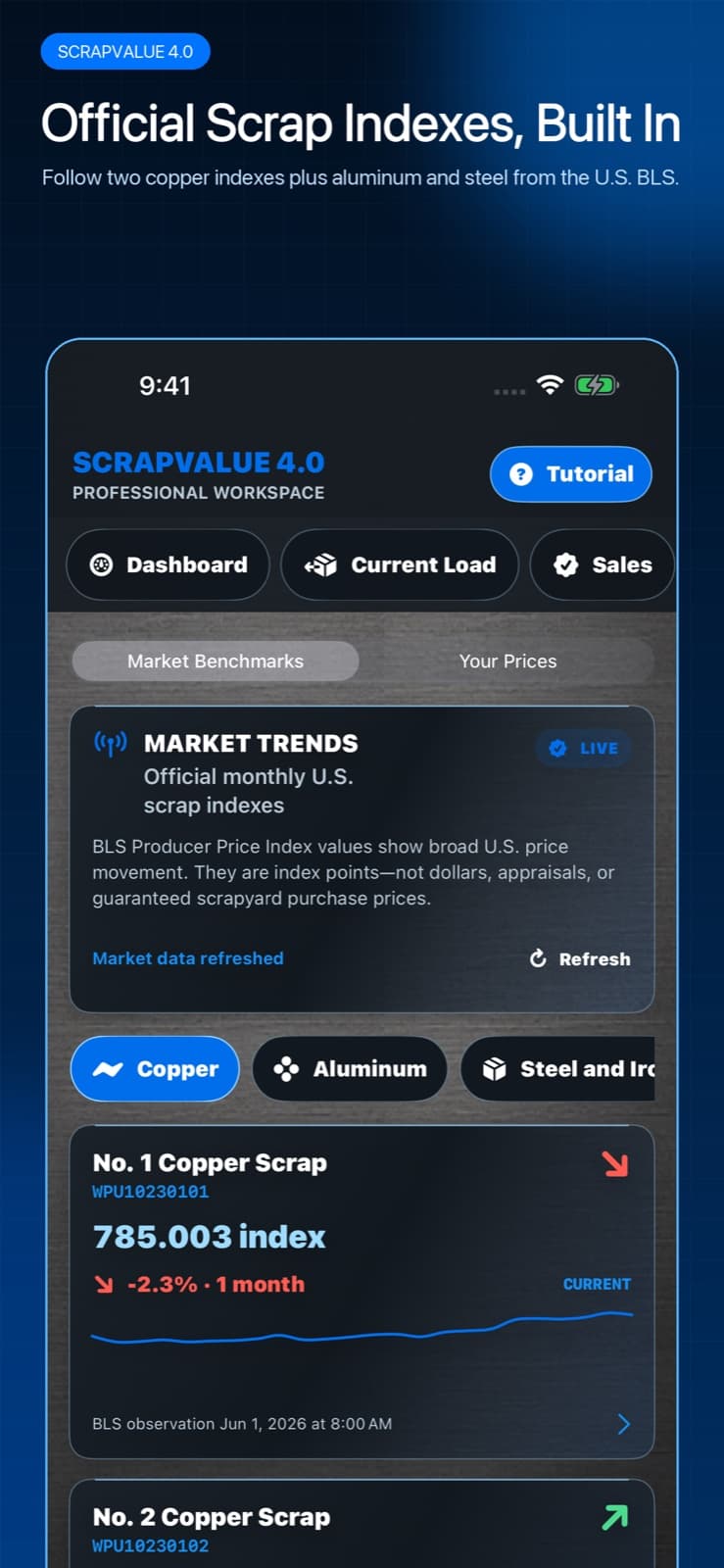
ScrapValue receives official BLS data through the Goodale Studios service and displays four Producer Price Index series selected for practical scrap-market context.
- No. 1 Copper Scrap, Including Wire — WPU10230101 — base: December 1986 = 100.
- No. 2 Copper Scrap, Including Wire — WPU10230102 — base: December 1986 = 100.
- Aluminum Base Scrap — WPU102302 — base: 1982 = 100.
- Iron and Steel Scrap — WPU1012 — base: 1982 = 100.
What an index point means
An index compares a current period with the series' base period. If a base is defined as 100 and the current index is 150, the measured producer-price level is 50 percent above that base level. It does not mean the metal is worth $150, $1.50 per pound, or any other cash amount.
The copper and aluminum/steel series use different base periods, so their raw index values should not be compared as though the larger number identifies the more valuable metal. Read each series across time against itself.
Read direction, momentum, and volatility together
Direction answers the simplest question: is the latest index above or below the prior comparison period? Momentum describes how strongly recent observations have been moving. Volatility describes how uneven those movements have been. A rising series with high volatility is different from a smooth, steady rise.
Use the history chart to check whether the latest move is a one-month reversal, part of a longer trend, or still inside a choppy range. The app can summarize the data, but no signal guarantees what next month or a local yard will do.
Why the latest point is monthly and may be revised
BLS publishes these Producer Price Index observations monthly. The newest point is not a live market ticker, and official data may be revised under BLS procedures. ScrapValue shows the observation date and refresh state so you can distinguish a current official release from cached data.
When the network is unavailable, the app can continue showing a previously saved snapshot and identify it as cached or stale rather than pretending it refreshed. Goodale Studios retrieves the official series; it does not manufacture substitute values when BLS data is unavailable.
Use the trend to ask a better question
A broad downward copper trend might prompt you to refresh an old yard quote before loading the truck. A sharp move in steel may explain why a current offer differs from a receipt several months ago. That context is useful, but the final decision should still use today's accepted grades and a current quote from the buyer you may visit.
Three dates that answer three different questions
An observation month identifies the period represented by a BLS Producer Price Index value. It is not the minute when someone offered to buy your load. An app may display a timestamp on the first day of that month to place the point on a chart; that does not turn the monthly series into a daily quote.
A provider release date tells you when a new observation became available. A backend fetch date tells you when the website last retrieved the provider response. These can be weeks apart. A successful daily fetch can correctly return the same monthly observation for many days. The current website schedule checks once a day at 11:15 UTC—7:15 a.m. Eastern daylight time or 6:15 a.m. Eastern standard time. It does not mean BLS publishes every day.
Read “Current” as a cache-health statement, not proof that the observation is from this morning. When checking freshness, note both the latest observation month and the last successful fetch, then consult the BLS publication schedule. Do not convert an index-point value into dollars per pound or use a rising trend as a promise of tomorrow’s local offer.
- A recent fetch plus an older observation can be normal for a monthly series.
- A stale fetch or provider failure needs a service check; it is not a market signal.
- Use a current yard quote for payout estimates. Keep BLS charts as broader context.